Performance
High-concurrency performance
Rust’s async ecosystem keeps sub-millisecond scheduling and stable performance in high-concurrency media scenarios.
5,000+ concurrent calls on a single server
SIP trunking, intelligent routing, real-time billing, CDR analytics, and observability in one open-source softswitch.
For global enterprises, VoIP wholesalers, cloud communications platforms, and CPaaS providers.
Products
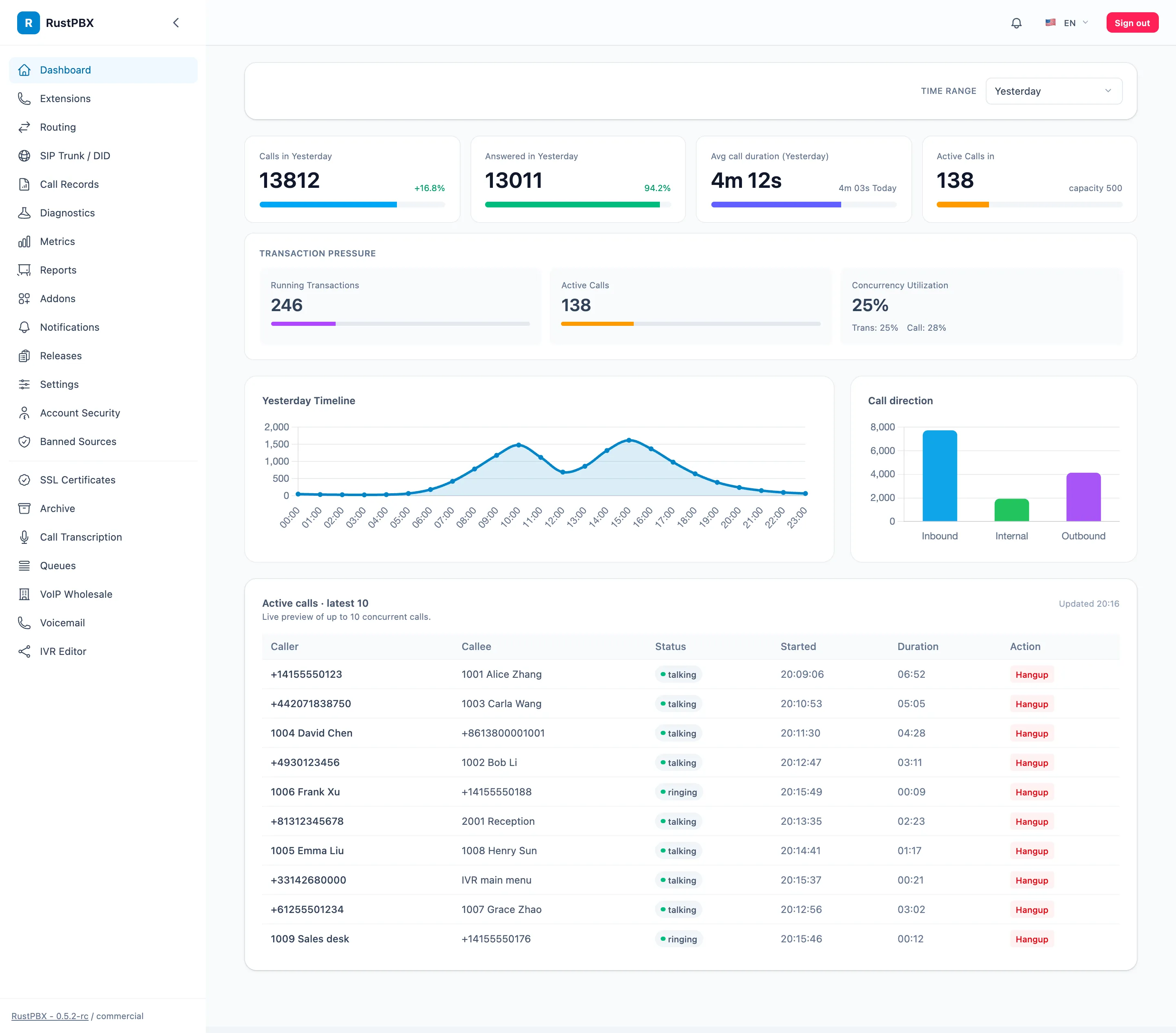
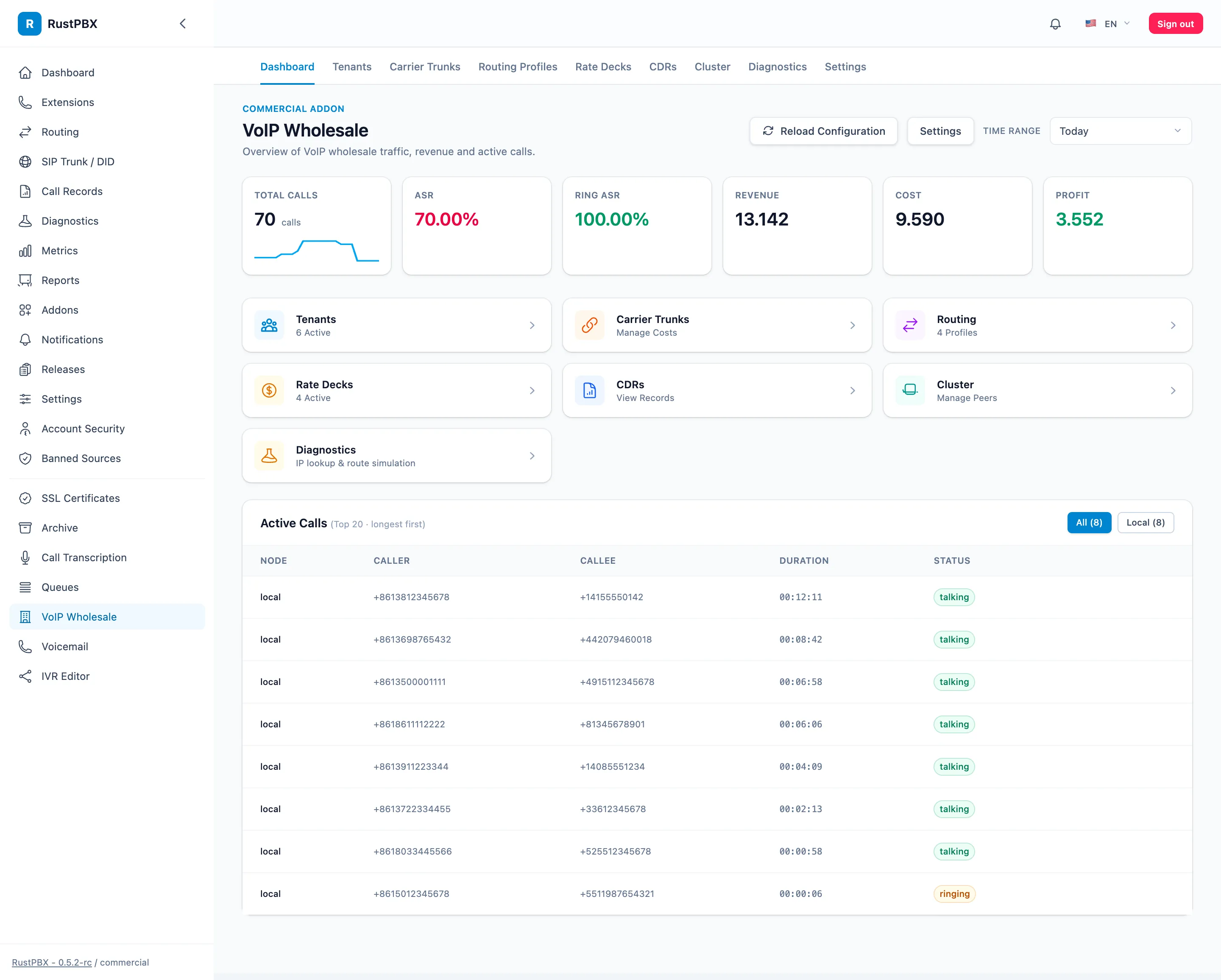
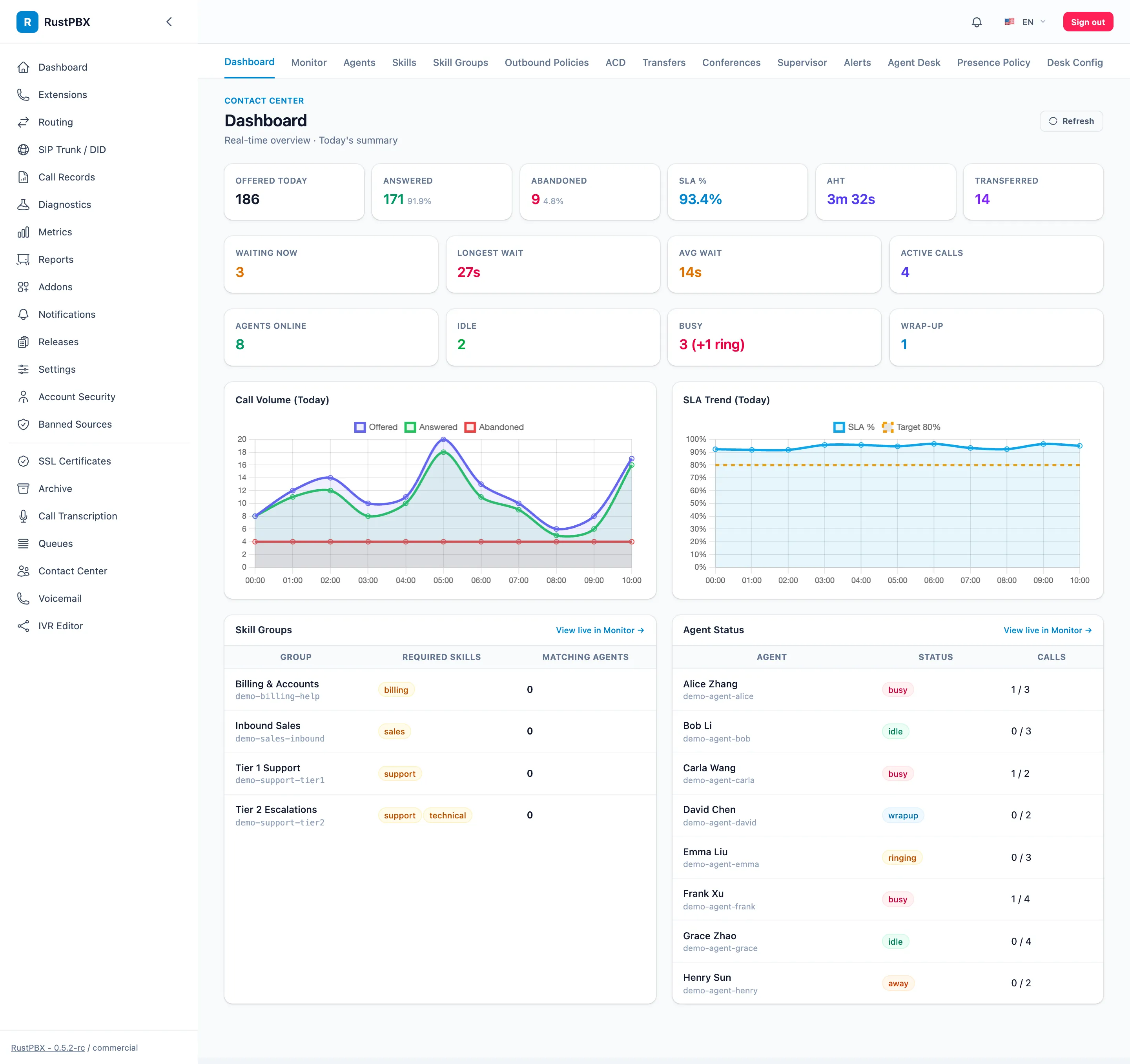
PBX, wholesale softswitch, and call center share the same SIP proxy, media engine, CDRs, and control plane. Enable the commercial plugins you need.
Capabilities
Every call takes the same path through one core: checked at the edge, routed to the best carrier, rated in real time, traced end to end and rolled into reports.
Inbound call · INVITE +44 20 7946 0958
Carrier-grade reliability built on the Rust async runtime, with layered protection.
Precise control over call paths, quality, and carrier selection.
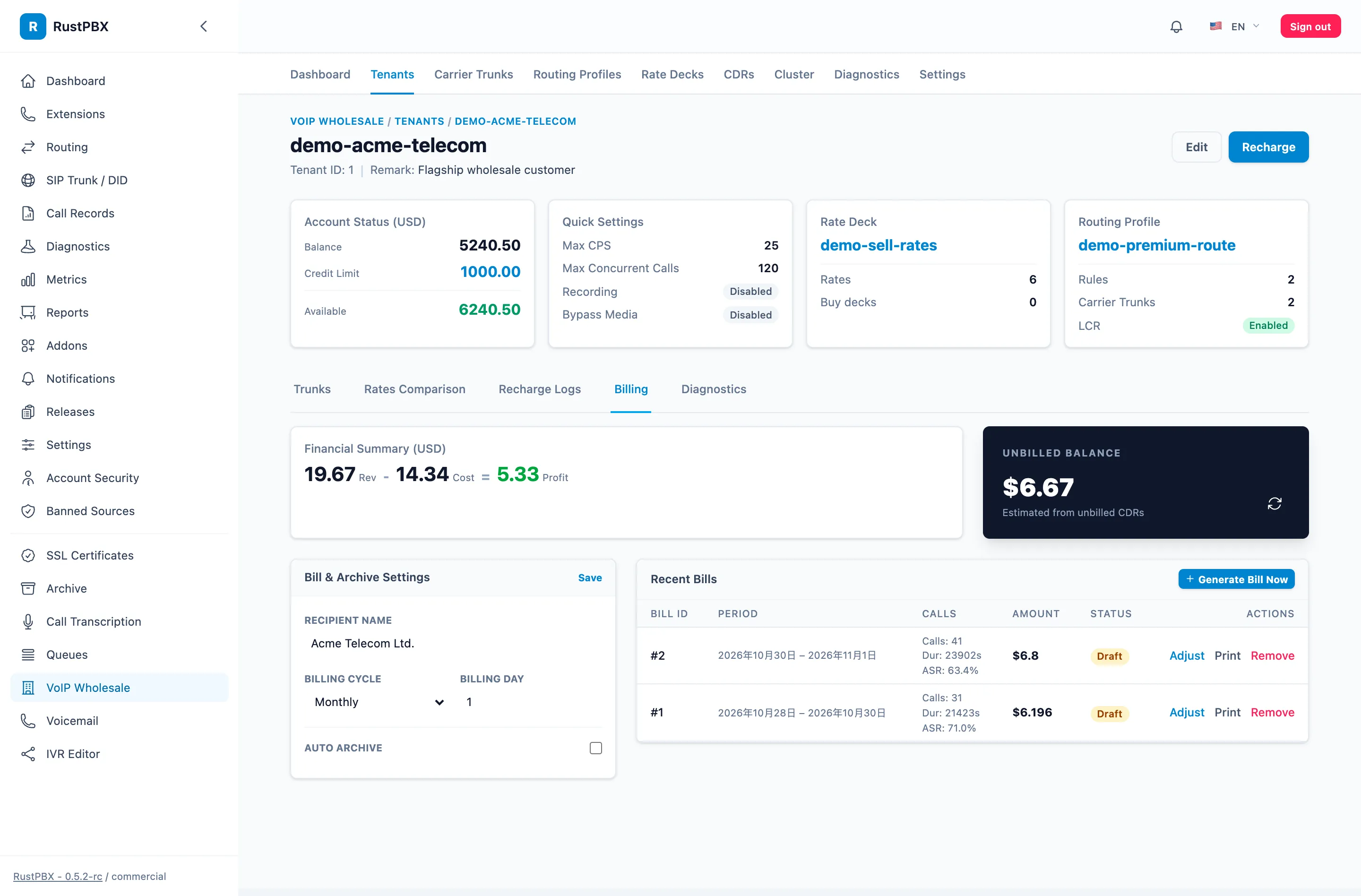
Real-time billing, credit control, and invoicing for prepaid and postpaid services.
Trace every call from SIP signaling to RTP media quality.
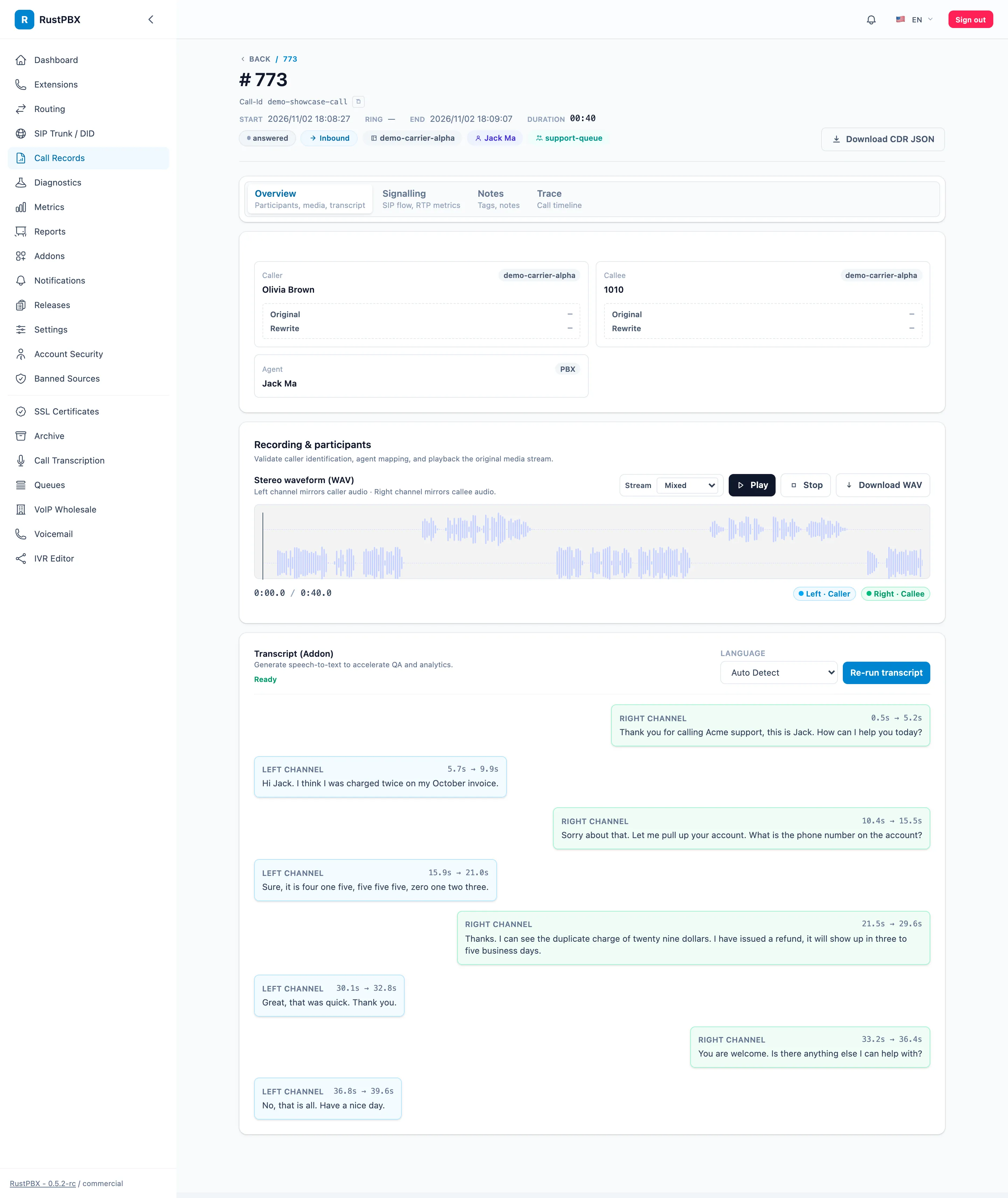
Detailed insights by route, tenant, and agent team.
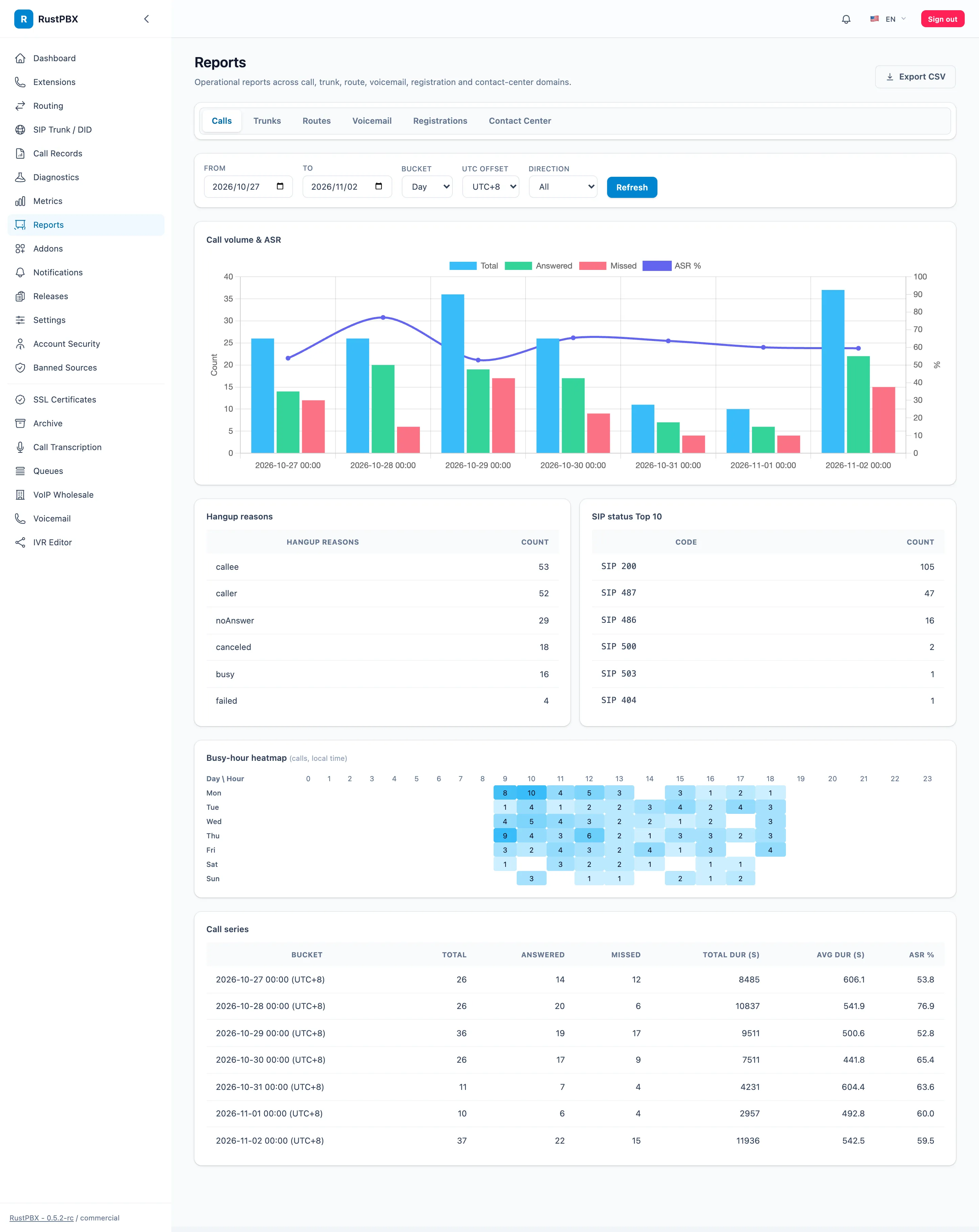
BYE · CDR written
Highlights
Performance
Rust’s async ecosystem keeps sub-millisecond scheduling and stable performance in high-concurrency media scenarios.
5,000+ concurrent calls on a single server
Security
WebRTC and SRTP (DTLS / SDES), SIP over TLS, and WebSocket, with support for G.711, G.722, G.729, Opus, and iLBC.
SRTP · SIP over TLS · WebRTC · Opus · G.722
Extensibility
HTTP dynamic routing, Step IVR, RWI over WebSocket and REST, webhooks, and a plugin system.
REST · RWI WebSocket · Webhooks · Addons
Voice agents
Your app runs the conversation. It exchanges audio over WebSocket and uses RWI to answer calls or transfer callers to your team.
Choose a supported endpoint. The built-in RustPBX adapter streams the caller’s speech to the model and plays its replies back.
Compare
Asterisk and FreeSWITCH are proven systems. RustPBX targets a different operating point: one memory-safe core with a modern control plane, built for clusters and automation.
| RustPBX | FreeSWITCH | Asterisk | |
|---|---|---|---|
| Language / safety | Rust (memory-safe) | C | C |
| Signaling + media in one runtime | Yes, async tasks on a shared runtime | Yes, a thread per session (pooled) | Yes, a thread per channel |
| Cluster session registry | Built in | External design | External design |
| Control plane | REST + RWI WebSocket | ESL | AMI / ARI |
| Wholesale billing / BSS | Integrated addon | External | External |
| Call Center / ACD | Integrated addon | Via FusionPBX etc. | Third-party |
| License | MIT core + commercial addons | MPL | GPL / commercial |
Customers
Supporting SMS and voice communications providers and ride-hailing platforms. These anonymous case studies show how customers use Miuda in production.
SMS & voice communications · 200 employees
Complex routing, fragmented tenant management, lengthy settlements and growing compliance requirements made wholesale VoIP operations difficult to scale. The provider needed more precise tenant management, automated billing and better use of carrier resources.
Routing by tenant and business rules improves carrier resource utilization. Bulk management, automated billing and policy distribution streamline operations, while route optimization, audit trails and risk controls help reduce operational risk.
Ride-hailing · 3,000+ call-center agents
Peak call volumes risked delays and service interruptions. Long queues and slow responses affected drivers and passengers, increasing churn risk, while a call center with more than 3,000 agents carried substantial staffing and management costs.
Cluster deployment and elastic scaling support peak demand and reliable communication. Voice bots handle frequent, routine tasks around the clock to reduce operating costs. Fast responses and collaboration between AI and human agents improve the driver and passenger experience.
FAQ
Yes. The RustPBX core is open source under the MIT license, including the SIP proxy, media engine, call records and web console. Clustering is part of the open-source core; commercial editions add licensed addons such as one-step cluster management, wholesale billing and the call center.
SIP over UDP, TCP and TLS, SIP over WebSocket for WebRTC, and SRTP including DTLS-SRTP and SDES-SRTP. Codecs include G.711 a/µ, G.729, G.722, Opus and iLBC, selectable per trunk or extension, with transcoding in the media bridge.
Yes. The wholesale addon adds tenant management, rate decks, routing profiles with least-cost routing, circuit breakers with sliding-window ASR/ACD monitoring, real-time billing and per-tenant CDRs — a complete class 4 softswitch and BSS stack.
Skill-based ACD queues, agent states with wrap-up, overflow strategies, live supervisor monitoring with listen / whisper / barge-in, screen-pop with Call-Info / User-to-User headers, and post-call CSAT surveys.
Yes. ASR/TTS drivers, per-call transcription, a realtime AI-voice bridge for LLM agents and an IVR engine with dynamic prompts let you build voice agents that hand off to humans on the same platform.
With Docker or as a single static binary on Linux. The built-in web console handles extensions, trunks, routing and diagnostics. SQLite works out of the box; MySQL or PostgreSQL is recommended for clusters.
Start a 7-day trial, or tell us your scale and we’ll walk through routing, queues and billing with you.
We use Google Analytics cookies to improve the site. Analytics loads only after you accept. Privacy