Rust-native PBX

RustPBX: A high-performance, secure, fully open voice core

RustPBX is maintained by the miuda.ai team and released fully open source. Built in Rust, it pairs realtime performance with memory safety, delivering carrier-grade reliability alongside a modern developer experience for AI-native voice applications.

Why RustPBX?

RustPBX embraces an observable, extensible PBX architecture: the core modules run efficiently on the Rust runtime, while downstream systems integrate through APIs, webhooks, or WebSocket event streams to sync with AI assistants, CRMs, ticketing, and more.

  • Open source under MIT—customize and extend without restriction
  • Security-first design avoids memory risks common in legacy PBX stacks
  • Cloud-ready deployment model that fits CI/CD and infrastructure-as-code pipelines

Get started fast

Launch with docker compose or Kubernetes, then connect with the RustPBX SDK to complete your first call flow in minutes.

Quick start guide

A voice platform engineered for builders

A scalable foundation that spans media, orchestration, and compliance so teams can trust their voice core.

Performance

Rust-grade concurrency

Rust's async ecosystem keeps sub-millisecond scheduling even in high-concurrency media scenarios, ensuring consistent call quality.

Open

Full-stack open ecosystem

Core code, SDKs, and ops tooling are open sourced for community-driven plugins and bespoke voice + AI workflows.

AI Ready

Event-driven AI integration

WebSocket / gRPC event buses stream call state in realtime for seamless AI agent, QA, and knowledge base integrations.

Core calling capabilities

A carrier-grade voice core that covers access, media, and call control with deterministic latency.
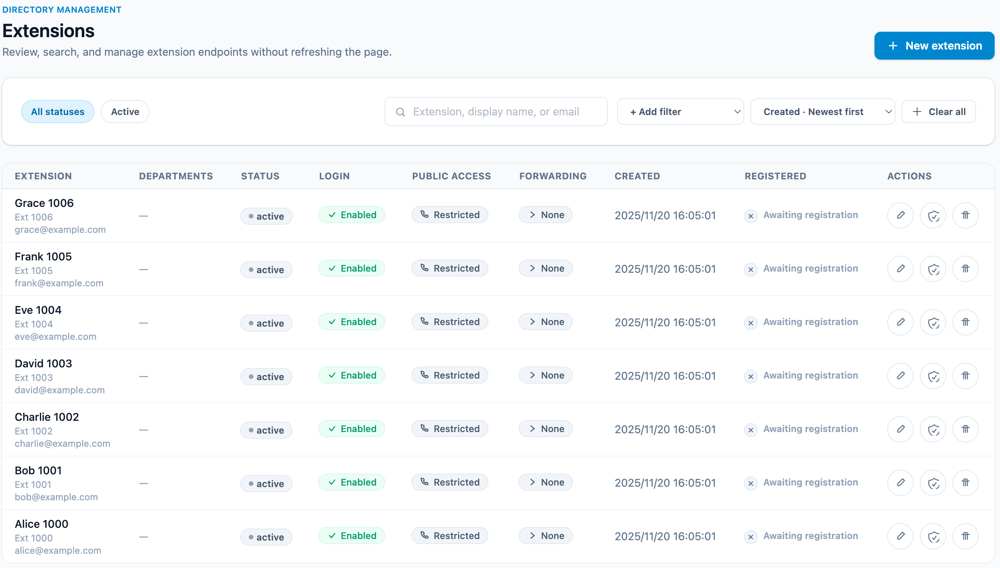
  • Unlimited extensions with per-device concurrent login policies
  • Codec support: G.711 / G.722 / G.729 / Opus
  • Built-in WebRTC and SRTP for encrypted, cross-platform sessions
  • SIP over WebSocket for seamless browser endpoints
  • DTMF passthrough via RFC2833 and SIP INFO
  • Native recording, attended and blind transfer, and three-way calling
  • Adaptive call queues with hold music, retries, overflow routing, and more
Feature screenshot

Configurable operations

Visual tooling turns complex routing and billing logic into intuitive workflows.
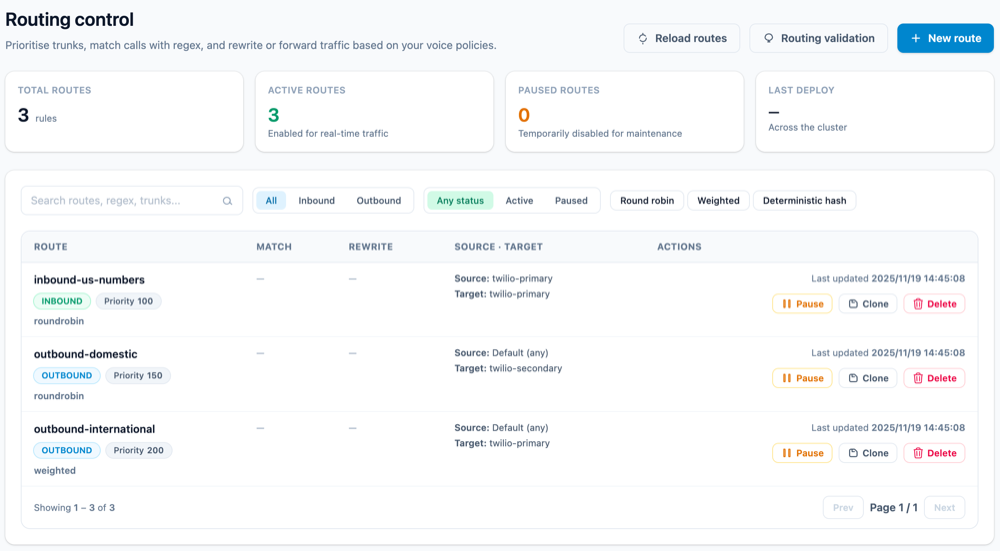
  • Visual routing rules with an advanced drag-and-drop editor
  • SIP Trunk and DID onboarding with capacity management
  • Custom billing templates, including department-level chargeback
  • Rich call detail records with transcription and export
Feature screenshot

Engineered for operations teams

Full-stack tooling for DevOps and voice engineers to deploy, debug, and scale with confidence.
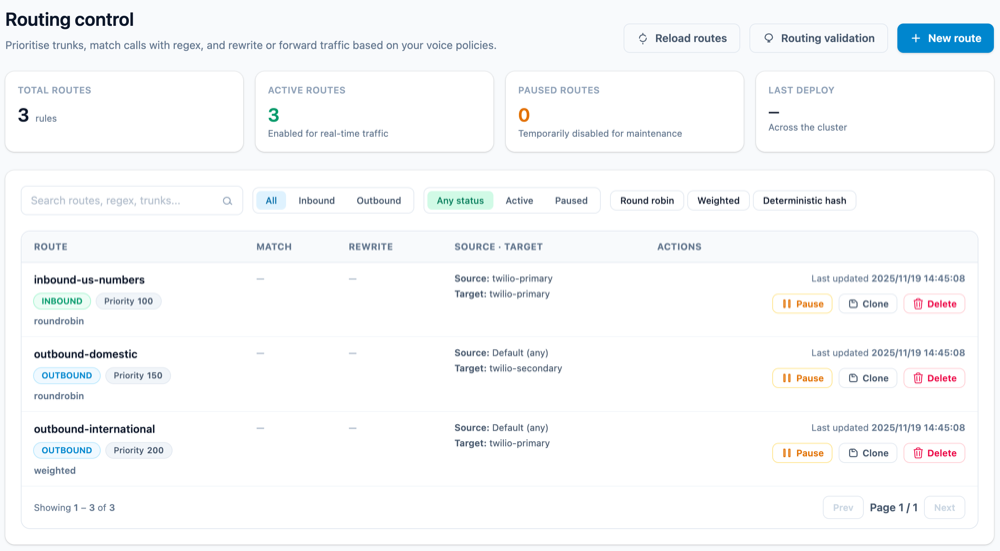
  • In-browser routing and SIP trunk tests powered by WebRTC + SIP over WebSocket
  • Live lookup for calls, registered devices, and endpoint status
  • Advanced admin console with observability and audit trails
  • Multi-account, multi-department, role-based access control
  • Support for MySQL, PostgreSQL, and SQLite backends
  • Guided IVR design and publishing pipeline
Feature screenshot

Production-grade security posture

Defend high-concurrency, real-time voice workloads from access to data lifecycle.
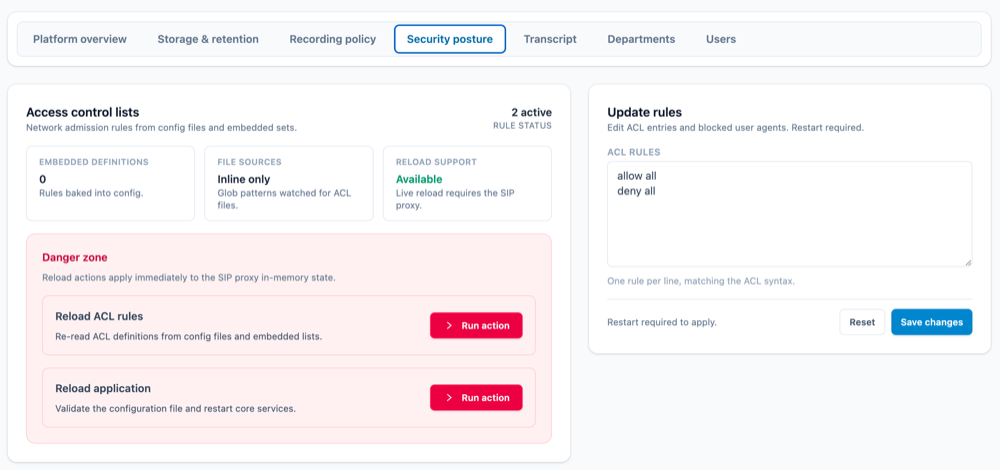
  • Embedded firewall with IP and User-Agent allow/deny policies
  • Configurable call concurrency caps and rate limits to absorb spikes
  • Automated archival with scheduled backups to S3-compatible storage
  • Standardized Docker-based deployment for consistent environments
Feature screenshot

Ready to build the next-generation voice platform?

Talk with us about enterprise deployment, migration planning, or bespoke development. We welcome community contributors who want to shape the future of PBX with our engineering team.